
India's urban unemployment rate for individuals aged 15 and above marginally increased to 6.7 per cent in April-June, while rural unemployment rose to 4.8 per cent, according to the latest Periodic Labour Force Survey (PLFS). This rise in unemployment coincides with a notable decline in the overall labour force participation rate (LFPR) to a five-quarter low of 54.6 per cent.

India's overall unemployment rate for individuals aged 15 and above decreased to 5.1 per cent in July 2026, down from 5.5 per cent in June 2026, according to the latest Periodic Labour Force Survey (PLFS) by the National Statistics Office (NSO).

The number of individuals who declared a gross income of Rs 100 crore or more in their income-tax returns had risen to 301 in 2022-23, moderated slightly to 284 in 2023-24, then climbed to 415 in 2024-25.

The number of individuals reporting a gross total income of 100 crore or more in their income tax returns has quadrupled to 576 in Assessment Year 2025-26, up from 142 in AY 2021-22, according to data shared in Parliament.

A recent Central Vigilance Commission (CVC) report reveals that over 70,500 corruption complaints were lodged against various government bodies last year, with banks and the Railways accounting for the highest numbers. While a significant portion of these complaints has been disposed of, thousands remain under process, highlighting ongoing challenges in addressing corruption within public sector entities.

In many ways, 17th century India occupied a position in the global economy comparable to that of the United States today. Just as millions of people now look towards America because of its economic opportunities, merchants, adventurers and trading companies once looked towards India.
India's unemployment rate reached an 11-month high of 5.5 per cent in May, up from 5.2 per cent in April, according to the National Statistics Office, indicating a softening labour market as labour-force participation also eased.

Sumit Sarkar was never intellectually dismissive of the Hindutva project. He took it with deadly seriousness for he grasped the challenge it posed to the aspirations and ideals of the anti-imperialist movement that generated multiple imaginings of freedom and ways to attain it, recalls Pradeep Kumar Dutta.

Despite near gender parity in basic bank account ownership, women in India remain significantly underrepresented in the growing platform economy due to gaps in digital financial capability and access to credit, according to a joint report by the International Labour Organization and National Council of Applied Economic Research.

A Goldman Sachs report indicates that up to 12% of India's non-agricultural workforce is at risk of substitution by generative AI, while 42-48% could be complemented. The report highlights uneven impacts across sectors and job types, with IT-enabled services facing higher risk and physical tasks remaining less affected. Gen-AI is projected to boost India's labour productivity growth over the next decade.

Seventeen-year-old Naavya Shah's idea was simple -- source fresh flour from a women-run mill, sell it directly to customers and, wherever possible, put women in charge of the parts of the business they had traditionally been excluded from.

Two commercial vessels, an oil tanker and a cargo ship, carrying a total of 22 Indian nationals, were hijacked by armed pirates in separate incidents off Yemen and Somalia. All Indian crew members on both vessels are reported to be safe, according to the latest information from the shipping ministry and the External Affairs Ministry.

India's Code on Wages mandates strict payout deadlines, two-day full and final settlements, universal wage coverage and capped deductions to safeguard employees and enhance payroll transparency nationwide.

'It could be in IT, it could be in administration, it could be in legal, it could be in technical services, but entry level jobs are rapidly disappearing because AI is taking them over.' 'So, the big question what would happen if the bottom rung of the ladder is removed?'

India's unemployment rate for individuals aged 15 years and above reached a six-month peak of 5.2 per cent in April 2026, according to the latest Periodic Labour Force Survey (PLFS) data.

Haryana Labour Minister Anil Vij reveals a major scam in the labour department, with nearly 90% of work slips examined found to be fake. An investigation into the Haryana Building and Other Construction Workers Welfare Board reveals potential losses of thousands of crores of rupees.
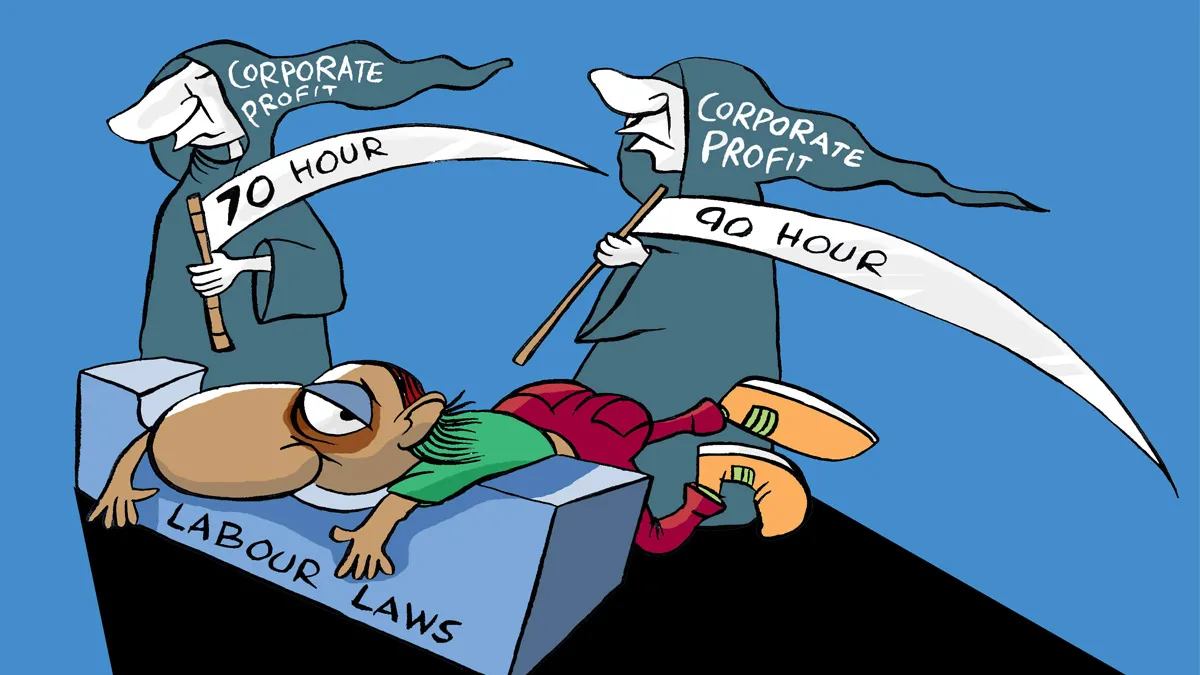
The Indian government has notified final rules under four labour codes, potentially enabling a four-day workweek in certain sectors by capping weekly working hours at 48 while allowing daily flexibility. This move also introduces significant changes to wage fixation, compliance obligations, and social security norms.

Amit Malviya paid the price because he committed the cardinal mistake of himself 'becoming' the BJP's IT Cell and its social media. Malviya's removal contains a message to others -- never try to become bigger than the job that has been assigned, explains Nilanjan Mukhopadhyay.

On camera, youngsters gave their names, where they'd come from, where they were studying or working - and then proceeded to criticize Modi. On camera, they held up posters mocking Modi, points out Jyoti Punwani.

Of the Rs 31,820.80 crore allocated to central sector schemes and projects, only Rs 11,868.05 crore was utilised, according to the revised estimates.

Keir Starmer has come under mounting pressure to resign as the leader of the Labour Party to pave the way for Andy Burnham to take over as the new British Prime Minister.

A new report by child rights NGO CRY reveals that nearly seven in every 10 school-going children across India missed school or routine activities from May to June this year due to extreme heat, with 76 per cent reporting negative impacts on their ability to focus on studies.

A new Accenture report reveals that nearly half of all global cybersecurity positions remain vacant, primarily due to a critical shortage of professionals with both technical expertise and essential business acumen. The report highlights a significant gap between the skills required for modern cybersecurity and what the labour market currently offers, exacerbated by poor retention and underinvestment in upskilling.

A referendum 10 years ago on this day set the United Kingdom on a new path as a non-member of the European Union (EU) and the turmoil of that Brexit vote continues to play out as the country prepares for its seventh prime minister in a decade.

India's unemployment rate saw a marginal decrease in February 2026, according to the Periodic Labour Force Survey (PLFS). The survey highlights changes in urban and rural unemployment rates, as well as labour force participation and worker population ratios.

Companies would have to recognise the increase in gratuity liability arising from new labour codes in their interim financial statements and results for the period ending December 31, the Institute of Chartered Accountants of India (ICAI) has said in its FAQs on the new labour codes.

Millions of EPFO subscribers can now check whether 8.25% annual interest for FY2025-26 has been credited to their provident fund accounts.

'The main problem the country faces is not low GDP growth, but low employment growth.'

Mumbai has spent four centuries building folklore around its monsoon: The potholes, the delayed trains, the office debates about whether it will 'break' this week or next. It turns out the rain was always a market. Nobody had built the exchange for it until now!

Mahindra & Mahindra (M&M) is expanding its farm equipment strategy beyond tractors to include a wider range of mechanisation solutions like harvesters, balers, seed drills, and telematics-enabled services, aiming to capitalise on the growing demand for rental services by rural entrepreneurs and address low mechanisation levels in Indian agriculture.

IndiGo, India's largest airline, reported a net loss of Rs 2,536.9 crore in the March quarter of fiscal year 2025-26, primarily attributed to a significant foreign exchange loss of approximately Rs 8,100 crore, the impact of December flight disruptions, and expenses related to new labour laws.
India's unemployment rate for individuals aged 15 and older increased to 5.1 per cent in March 2026, up from 4.9 per cent in February, primarily due to a rise in joblessness in urban areas, according to government data.

From All We Imagine As Light to Kishkindha Kaandam, these outstanding films deserved National Film Awards far more than several of this year's winners.

Diljit Dosanjh's film 'Satluj', based on human rights activist Jaswant Singh Khalra, has been made unavailable on ZEE5 in India just two days after its release, following a prolonged censorship battle.

Not a single retail outlet ran dry. Every household that wanted a cylinder got one. India faced neither a 1991 moment nor a 2013 one. Macroeconomic stability held. This was not an accident, and it was not luck alone. It was the work of a government that chose to act as it had during the pandemic -- deliberately and gradually, building one measure upon another rather than reaching for a single dramatic lever, explains V Anantha Nageswaran, chief economic advisor to the Government of India.

Cigarette-to-soap conglomerate ITC on Thursday reported a consolidated net profit (attributable to owners) of Rs 4,931.19 crore for the third quarter (October-December/Q3) of 2025-26 (FY26), affected by a one-time provision related to the new labour codes and a base effect from an exceptional item in Q3 of 2024-25. In the year-ago period, net profit had stood at Rs 4,934.8 crore.

IT services major Wipro on Friday reported a 7 per cent decline in consolidated net profit to Rs 3,119 crore in the third quarter of FY26, weighed by a one-time provisional impact of Rs 302.8 crore due to the implementation of new Labour Codes.

A new study indicates that India's monsoon season could experience a significant increase in uncompensable heat stress under a 2 degrees Celsius global warming scenario, extending the duration of extreme heat conditions.

The Delhi government is establishing a multidisciplinary committee to develop a regulatory framework for coaching institutes. This initiative follows recent tragedies, including the Saket building collapse and the Old Rajendra Nagar coaching centre incident, and aims to address issues like fee structures, student safety, infrastructure, and grievance redressal.

A three-storey under-construction warehouse in Kolkata's Taratala area collapsed, killing three people and trapping several others. Rescue operations are ongoing, with 18 individuals already saved, amid allegations of substandard construction materials and illegal building practices.
